Your security is only as strong as the suppliers you let in. NIS2 turns that old saying into a legal duty.
You host your data with a cloud provider. An MSP manages your laptops. A payroll service holds your employee records, and a small software vendor has remote access to your production line. Then a client sends a security questionnaire and asks how you assess all of them. Before you know it, you are digging through contracts and old emails to find out who actually has access to what.
That is not the exception. For most SMEs, supplier security has grown by accident rather than by design. The good news: a workable supplier assessment does not need a procurement department. It needs a clear list, a sensible risk split and a fixed rhythm.
What NIS2 actually asks of your supply chain
Article 21 of NIS2 lists supply chain security as one of the minimum measures every essential and important entity must take. That covers the security aspects of the relationship with your direct suppliers and service providers. Article 21(3) adds that you must consider each supplier’s specific vulnerabilities, the quality of its products and its cybersecurity practices, including how it develops software.
NIS2 does not hand you a checklist. It asks for measures that are proportionate to your risk. For digital service providers such as cloud, data centre and managed service providers, Implementing Regulation (EU) 2024/2690 goes further and expects a documented supply chain security policy and an up-to-date supplier list.
And even if NIS2 does not apply to you directly, it probably reaches you anyway. Your NIS2 clients have to assess their suppliers, and you are one of them. Expect the questionnaires, audit clauses and contract requirements to flow down the chain.
Assessing your suppliers in five steps
You do not need to audit every supplier in depth. You need to know where the risk sits and spend your effort there.
- Make a list. Start with every supplier that touches your data, your systems or your premises. Think beyond IT: cleaning companies with building access and accountants with your financial data count too.
- Classify by impact. Ask two questions per supplier: what happens if they are breached, and what happens if they are unavailable for a week? That gives you a simple split into critical, important and low-risk suppliers.
- Assess in proportion. Critical suppliers get a questionnaire and a check on certificates such as ISO 27001 or a SOC 2 report, including the scope. For low-risk suppliers a short check is enough.
- Put it in the contract. Agree on security requirements, incident notification within a fixed time, the right to audit, subcontracting and what happens to your data when the contract ends.
- Monitor and repeat. Review critical suppliers at least once a year, and again after an incident, a takeover or a change in service. An assessment from three years ago tells you very little.
In our experience, most SMEs end up with fewer than ten truly critical suppliers. That makes the work far more manageable than it first looks.
You are probably doing half of this already
If you work with ISO 27001, the supplier part of NIS2 will look familiar. Annex A controls 5.19 to 5.23 cover supplier relationships, security in supplier agreements, the ICT supply chain, monitoring of supplier services and the use of cloud services. NEN 7510 for healthcare follows the same structure.
That means one supplier assessment can serve ISO 27001, NIS2 and your clients’ questionnaires at the same time. The trap is to run them as separate exercises, with a supplier list for the auditor, another for the NIS2 project and a third in a procurement spreadsheet. Three lists means three versions of the truth, and at least two of them will be out of date.
One supplier list for ISO 27001, NIS2 and client questionnaires? See how that works →
A certificate is not a free pass
The most common mistake is to file a supplier’s ISO 27001 certificate and consider the job done. Check the scope. A certificate that covers the head office in Utrecht says nothing about the data centre where your data actually lives.

The second mistake is treating the assessment as a one-off. Suppliers change owners, move data to other regions and add subcontractors. NIS2 expects your measures to keep up, and so do your auditors.
The third is forgetting the supplier’s suppliers. You only have to assess your direct suppliers, but it is fair to ask them how they manage theirs. If your MSP relies on a remote management tool, that tool is part of your risk too.
The five steps in ISOPlanner™
ISOPlanner™ follows the same five steps, inside the Microsoft 365 tools your team already uses.
- List: one supplier register in SharePoint, not a spreadsheet on someone’s desktop.
- Classify: a risk classification per supplier (critical, important or low-risk), visible at a glance.
- Assess: questionnaires and certificates, including their scope, stored with the supplier.
- Contract: agreements linked to the supplier and to the controls they support.
- Monitor: annual reviews as recurring tasks in Outlook and Teams, so they do not depend on someone’s memory.
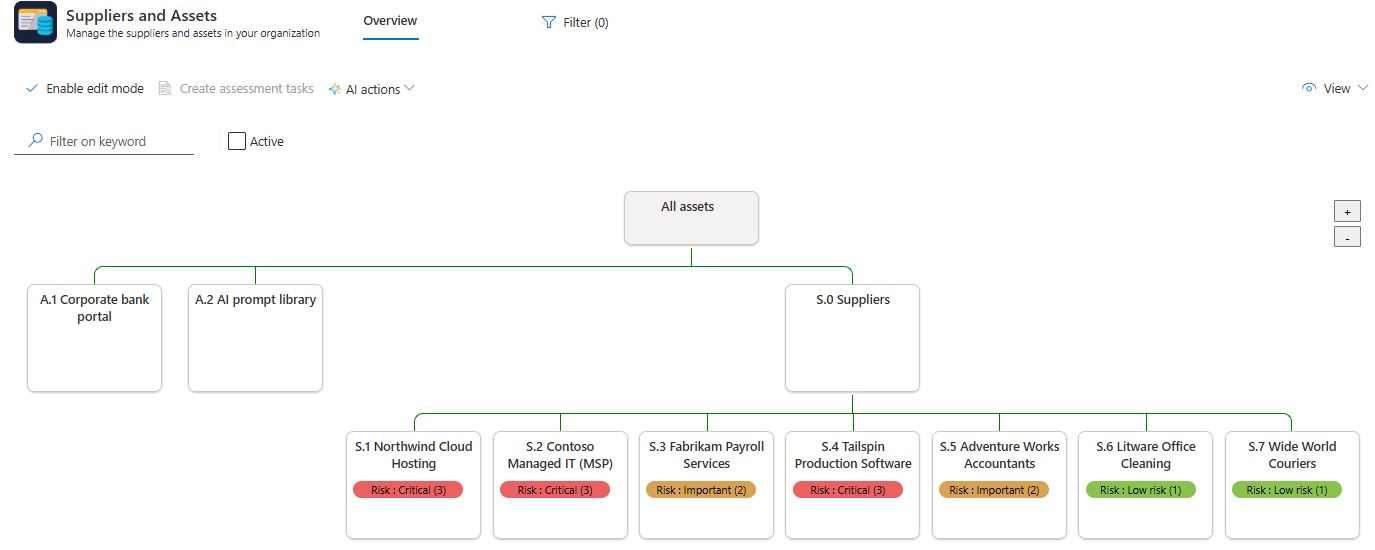
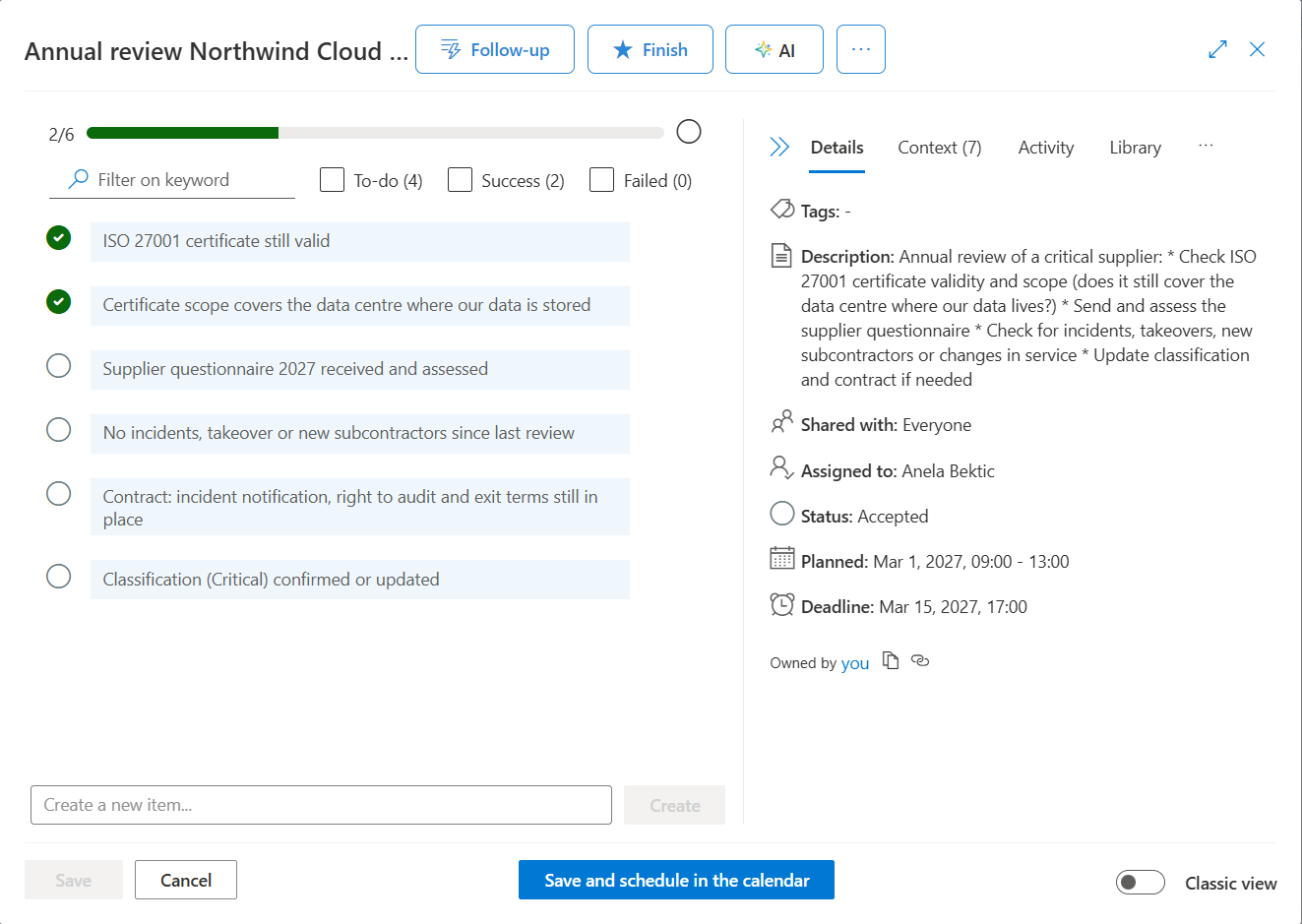
Because you link each assessment to the controls it supports, the same evidence counts for ISO 27001, NIS2, NEN 7510 and any of the other 50+ frameworks you work with. When an auditor or client asks how you manage your supply chain, you show one current overview instead of three spreadsheets.

See your supplier register in Microsoft 365
In a demo we show how ISOPlanner™ keeps your suppliers, risk classification and reviews in one place, mapped to ISO 27001 and NIS2. No obligation.
Prefer to look around first? Try the interactive demo →